Showing posts with label sports car. Show all posts

Tuesday, October 19, 2010

2011 Pagani Zonda Tricolore - Pagani Unique Hypercar

Pagani Automobili created the Pagani Zonda Tricolore on the occasion of the celebration of the 50th Anniversary of the "Frecce Tricolori", as a tribute to the National Aerobatic Team.
2011 Pagani Zonda Tricolore
Pagani will introduce the rare cars in the Geneva Motorshow, the 2011 Pagani Zonda Tricolore. Pagani has come up with a new carbon fibre finish for the body of the Zonda Tricolore and there are unique air intakes mounted on top of the rear wings styled to look like the intakes of the jet fighters used by the display team.
2011 Pagani Zonda Tricolore
In 2010 the aerobatic season of the Frecce Tricolori comes to its 50th anniversary, wich will be celebrated on 11th and 12th September at Rivolto Airport.
2011 Pagani Zonda Tricolore
The Frecce Tricolori (Italian, literally Tricolour Arrows), officially known as the 313th Aerobatic Training Squadron is the demonstration team of the Italian Air Force, based at Rivolto Air Force Base, in the north-eastern Italian region of Friuli Venezia-Giulia, province of Udine. They were formed in 1961 as an Air Force team, replacing previous teams that had been sponsored by various commands by the end of the 1920s.
2011 Pagani Zonda Tricolore
The Tricolore comes with a 678bhp version of the Zonda’s 7.3-litre V12, Mercedes-sourced engine and it’s good for 0-62mph in 3.4 seconds and a top speed of 220mph. You’ll need to be as quick as the FrecceTricolore to grab the £1.3 million Pagani Zonda Tricolore though, as Pagani reports several customers have shown an interest in buying the unique hypercar. You should see the Photos Car of the unique design.
2011 Pagani Zonda Tricolore
The team flies the Aermacchi MB-339-A/PAN, a two-seat aircraft capable of 898 km/h at sea level, with nine aircraft and a solo (the highest number of aircraft of any aerobatic team in the world).
2011 Pagani Zonda Tricolore
The Frecce Tricolori belong to the legacy of the entire Italian community. This special edition Zonda is named after the Italian air force aerobatics team, known as the Frecce Tricolori. Italian colored stripes (red, white, green) running up the nose of the car and LED running lights set this Zonda apart from the others. Only 1 will be made at a cost of $2.75 million.
2011 Pagani Zonda Tricolore
READ MORE - 2011 Pagani Zonda Tricolore - Pagani Unique Hypercar

Sunday, October 17, 2010

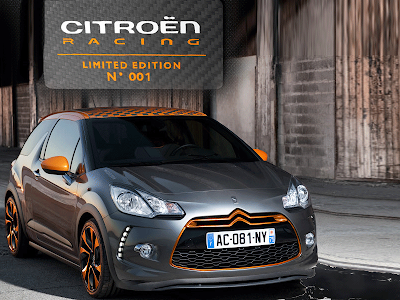
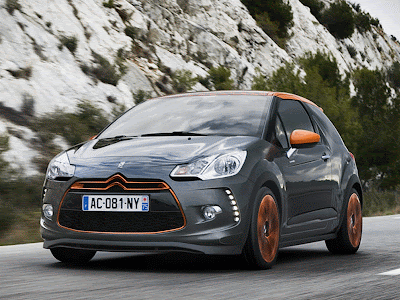
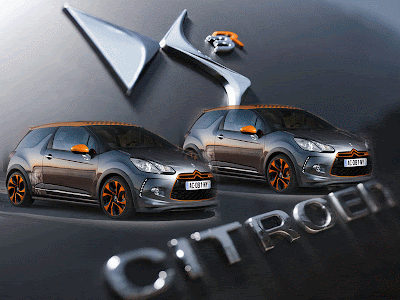
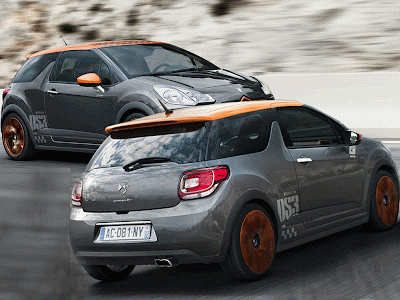
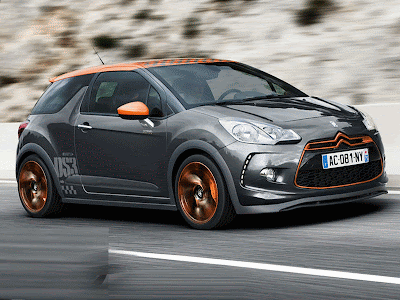
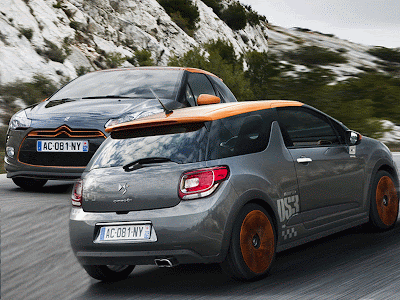
2010 Citroen DS3 Racing Car Limited Edition

Citroen plans to unveil a limited edition of the Citroen DS3 next month at the Geneva Motor Show. The Citroen DS3 Racing is a suped up version of the company's luxe supermini. While only 1000 units will be built, Citroen Australia General Manager, Miles Williams said that local availability for the special DS3 Racing will be announced when the regular DS3 launches in August.
2010 Citroen DS3 Racing Car Limited Edition
“The Citroen DS3 Racing represents an outstanding concentration of behind-the-wheel thrills with an artful blend of performance and efficiency. The DS3 Racing provides a clear indication of what we can expect when the DS3 arrives in Australia in August.” Mr Williams said.
2010 Citroen DS3 Racing Car Limited Edition
Developed by Citroën Racing - the winning team behind five WRC manufacturer's titles and six driver's titles for Sébastien Loeb and Daniel Elena - Citroën DS3 Racing is a special edition with a 100% sporting pedigree. Planned for the second half of 2010, the exclusive Citroën DS3 Racing will be limited to just 1000 production units.
2010 Citroen DS3 Racing Car Limited Edition
As such, the car's output has been bumped up by 30% to 200 PS (147 kW / 197 hp) using the turbocharged 1.6-liter THP engine. Torque is improved by 15% to 275 Nm (203 lb-ft). These changes were achieved by remapping the engine control unit, adjusting the turbo, and adjusting powertrain components.
2010 Citroen DS3 Racing Car Limited Edition
Meanwhile, stiffer suspension springs and new shock absorbers are also installed. The car has been lowered by 15mm, while both the front and rear track were widened by 30mm. Along with the new tires wrapped around the 18-inch wheels, the changes "all dramatically change the driving dynamics," according to a press release.
2010 Citroen DS3 Racing Car Limited Edition
To handle the extra power, the company installed four-piston caliper brakes up front and ventillated discs in back. Carbon-fiber touches are used on the new air diffuser, front bumper, lower body, and wing extensions. Chrome is also used at certain points, like the door handles and exhaust, with orange tint on the calipers, grille, roof, side mirror caps, and wheels. Inside, designers added carbon trim and orange inserts. Purposeful sport seats were also installed.
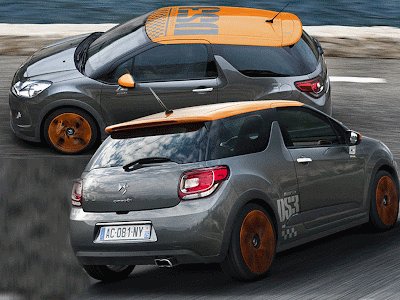
A Citroën DS3 Racing signature on the rear tailgate and an individually numbered identification plate fixed to the roof-lining further confirm the model's exclusivity.
2010 Citroen DS3 Racing Car Limited Edition
At 3.94-meters long, the grey and orange car will be shown in Geneva with checkered flaq and DS3 Racing graphics. Based on the existing DSport powered by the THP 150, production Citroën DS3 Racing editions will be finished in a special workshop and fitted with a parts kit developed according to Citroën Racing specifications. Only 1000 units of the Citroen DS3 Racing will be produced. The car will be released in the second half of 2010.
READ MORE - 2010 Citroen DS3 Racing Car Limited Edition

Friday, October 15, 2010

2010 Aston Martin DBS Edo Competition Luxurious Sports Car

Edo Competition Aston Martin DBS is a result of a modification carried out by Edo Competition Motorsport for the 12-cylinder Aston Martin that already produces 517 horsepower and has a top speed of more than 300 km/h (186 mph). Improving and underlining the elegance and beauty of this British triumph and strengthening its sporting character was the goal declared by Edo competition.
2010 Aston Martin DBS Edo Competition
The first step taken by Edo Competition was improving the power output. The DBS’s engine control unit was modified via software recalibration, then supported by a new high performance exhaust system, and was fitted with special catalytic converters and high flow air filters. As a result, the DBS’s power output was increased from 517 hp and 570 Nm (420 ft-lb) to 550 hp and 600 Nm (442 ft-lb), an enough power to accelerate from 0 to 100 km/h (62 mph) in 4.1 seconds and continue on to a top speed of 320 km/h (199 mph).
The high performance exhaust system, which was specially designed for the DBS, incorporates butterfly valves allowing it to produce a fantastically rich and sonorous sound. They further help increase the British luxury sports car coupe`s power and torque output. The exhaust comes with a programmable control system that monitors backpressure inside the exhaust and opens the 70 mm butterfly valves when a pre-determined level of backpressure is exceeded.
The unique advantage of this system is that it provides good torque at low engine speeds without sacrificing top end horsepower. The exhaust system is made from stainless steel and the chromed exhaust tips accentuate the elegant design. The driver can adjust the sound of the DBS at any time using a remote control.
Dealing with the levels of grip, Edo competition offers a new wheel design, a set of 21 inch racing wheels. The three-piece wheels come with stainless steel outer rims and the customer can choose the stock tire dimensions
Further, Edo competition has developed a new high performance brake system, 405 mm rotors with 6-piston monoblock calipers and performance brake pads for the front and 380 mm rotors with 6-piston monoblock calipers and performance brake pads for the rear, both including braided stainless steel brake lines.
As with all edo competition models, we set no limit to our customers` imaginations. Special interiors or lavish leather upholstery, individual requests are accommodated and executed with quality.
The modifications of this Edo competition Aston Martin DBS are all carried out at Edo competition Motorsport GmbH in Ahlen, Germany.
READ MORE - 2010 Aston Martin DBS Edo Competition Luxurious Sports Car

Wednesday, October 13, 2010

2010 speedART BTR-II 650 EVO New Design Porsche Sports Cars 997 Turbo

This is the SpeedART BTR II 650 EVO, the latest tuning package from the Porsche cars tuner SpeedART. The car is based on the 2010 Porsche 911 Turbo 3.8l with PDK-gearbox. SpeedART has come up with the new generation Bi-Turbo-Racer that possesses highly improved performance figures and an aerodynamic body kit.
2010 speedART BTR-II 650 EVO New Design Porsche Sports Cars 997 Turbo
The modification carried out by speedART has provided the 997 Turbo with custom wheel and suspension, custom body kit, as well as enhanced power. Power is enhanced by modifying the vehicle’s motronic to increase the power boost and mounted bigger VTG-turbo chargers, new sport exhaust with sport cats and twin tail pipes plus sport headers/manifolds, sport air filter and enlarged intercoolers. Due to these modifications, the Porsche 997 got an extra 150hp and 150 Nm.
2010 speedART BTR-II 650 EVO New Design Porsche Sports Cars 997 Turbo
To customize the wheel and suspension, speedART provides 997 Turbo with forged and weight reduced modular twin spoke wheels type „LSC FORGED = Light Spoke Competition“ in 8,5” and 12 x 20“ with 245/30 and 325/25 ZR20” in many different colors (price for complete set 6.640,- €). To harmonize, sportive and adjustable sport suspension in many different variations from type “street sport” up to or “race sport” incl. PASM function is available.
2010 speedART BTR-II 650 EVO New Design Porsche Sports Cars 997 Turbo
For the 997 Turbo exterior, speedART provides the speedART body kit “BTR-II EVO”, which consists of a new designed front bumper with spoiler lip and gun-metal frames for more downforce and better brake cooling (EVO-version), a new designed side skirts, rear diffuser and a rear spoiler with movable rear wing which is available in car color or original carbon. For the interior, speedART Individualize the new Porsche 997 Turbo with sport steering wheel for all models and with F1 shift paddles for PDK, sport seats with carbon shell in leather or alcantara, special leather or alcantara applications, and carbon interior parts in many colors as well.
2010 speedART BTR-II 650 EVO New Design Porsche Sports Cars 997 Turbo
Enhancing the 997 Turbo power, it is the speedART BTR-II 650 EVO (Bi-Turbo-Racer 2 generation with 650 hp), which is based on Porsche 997 Turbo with 3,8l engine and PDK shiftbox. The power increase of 150 hp and 150 nm consits of a modified motronic to enlarged the power boost in combination with bigger VTG-turbo chargers, a sport exhaust with sport cats and twin tail pipes plus sport headers/manifolds, sport air filter and enlarged intercoolers. With this power enhancement, speedART BTR-II 650 EVO Porsche 997 Turbo can accelerate from 0-100 km/h in 3,2 seconds and reach the top speed over 330 km/h.
2010 speedART BTR-II 650 EVO New Design Porsche Sports Cars 997 Turbo
READ MORE - 2010 speedART BTR-II 650 EVO New Design Porsche Sports Cars 997 Turbo

Thursday, October 7, 2010

2011 SLS AMG GT3 Mercedes-Benz - Luxurious Super Sports cars

The Mercedes-Benz SLS AMG is one of the biggest supercar releases of the past year. But the company isn't content with just making ultra luxurious supercars for the rich and well dressed, they also plan on releasing a fully homologated GT3 race version for the gentleman racer.
2011 SLS AMG GT3 Mercedes-Benz
The GT3 racing version of the SLS AMG is powered by the same mid-front mounted 6.3 litre V8 engine as the road car. There'll probably be a few modifications for the race unit, but Mercedes haven't yet announced final power outputs or specifications. Or even a final weight figure. That's all for the FIA to decide in the near future as part of the homologation process.
2011 SLS AMG GT3 Mercedes-Benz
Power transmission in the SLS AMG GT3 is done through a six-speed sequential racing transmission with steering wheel shift paddles and an integrated multi-disc locking differential. As in the SLS AMG road car, the transmission is located at the rear axle for better weight distribution: the engine and transmission are connected by a torque tube within which a carbon-fibre shaft rotates at the engine speed.
2011 SLS AMG GT3 Mercedes-Benz
The Mercedes SLS AMG GT3 is instantly recognizable as belonging to the SLS AMG family - as any GT3 racer is. The biggest visual changes are a new front apron, new splitter, redesigned bonnet with additional air intakes and vents, new sideskirts which have air inlets for cooling the rear brakes, rear diffuser and a prominent adjustable rear wing. The C-pillars provide housing for the standardized filler pipes for the fast-refuel system.
2011 SLS AMG GT3 Mercedes-Benz
The communication of Daimler release says that “the AMG V8 engine with 6.3-liter is identical to that used in the serial sports car. With a low weight, however, sports car accelerates from standstill to 100 km/h for only 3.7 seconds (serial sprint for 3.9 seconds). The maximum speed was announced for 300 mph, but producers say they have more opportunities to raise her brakes are racing by AMG, as disks are ventilated. Front wheels are size 12×18, rear 13×18.
2011 SLS AMG GT3 Mercedes-Benz
Powering this race car is a 6.3-Liter V8 engine that produces 600HP and controlling all this power is a six speed racing transmission system with shift paddles mounted on the steering wheel. The SLS AMG GT3 is designed as a racing sports car for customers competing in sprints and long-distance races.
"Thanks to uncompromising lightweight construction and superior handling dynamics, the SLS AMG provides an outstanding basis for a highly competitive racing car. This exciting GT3 version is our response to strong customer demand for a car designed for these attractive motor sports car series," says Volker Mornhinweg, Chairman of Mercedes-AMG GmbH.
2011 SLS AMG GT3 Mercedes-Benz
The body of the 2011 SLS AMG GT3 is the most significant difference from the road car starting with the aggressive front fascia and splitter to the massive rear spoiler. The hood of the race model is also very different from the normal SLS AMG with a large center cooling vent that helps to move air to cool the engine and the braking system. Along the side of the car, vents have been added to cool the rear brakes without compromising aerodynamics and all of these improvements to the overall cooling effort of the car makes it ideal for long road races like the 12 Hours of Sebring.
2011 SLS AMG GT3 Mercedes-Benz
The SLS AMG GT3 is equipped with a six-speed racing transmission with sequential shift. A steering wheel with a diameter of 13 inches facilitates perfect vehicle control. Because it is open at the top, the driver always has a perfect view of the central display, which provides all relevant information such as road speed, engine speed, operating temperatures, lap times and gear selection. The SLS AMG GT3 is also equipped with precisely calculated cooling channels – openings in the front skirt and ahead of the rear wheels direct cool airflow over the brake discs. All four brake discs are ventilated, slotted and drilled.
The 2011 Mercedes-Benz SLS AMG race car is expected to delivery scheduled prior to the start of the 2011 racing season. However, interested customers can order this awesome vehicle starting in autumn 2010. The Mercedes-Benz display at the 2010 New York Auto Show, the 2011 SLS AMG will carry a starting price-tag of $183,000 when it goes on sale.
READ MORE - 2011 SLS AMG GT3 Mercedes-Benz - Luxurious Super Sports cars

Tuesday, October 5, 2010

2010 BF-performance Lamborghini Gallardo GT600 Sports Car

In the Swiss city Zug, perfection has a different meaning than in the Italian town Sant’Agata Bolognese. While Lamborghini is satisfied with the Gallardo LP560-4, the Swiss have higher demands – at least the engineers at BF-performance.
2010 BF-performance Lamborghini Gallardo GT600
For them, the Gallardo is too innocent and neither dynamic nor individual enough. Therefore, they turn both the Coupé and also the Spyder into the GT600 which has a stronger performance, more self-confidence and looks more aggressive.
2010 BF-performance Lamborghini Gallardo GT600
Swiss tuning firm BF-performance, based in the wonderfully named city of Zug, have developed a comprehensive modification package for the Lamborghini Gallardo LP560-4. And in the process they've also renamed it the GT600.
2010 BF-performance Lamborghini Gallardo GT600
Not content with just making some pretty bits to stick onto the Gallardo LP560-4, the engineers at BF-performance also developed a number of performance enhancements and modification options for the drivetrain. Most significant is the option for a RWD only configuration - just like on the Gallardo LP550-2 Balboni edition. In total the other modifications have also rendered a weight reduction of 43 kgs (95 lbs) which further improves performance.
2010 BF-performance Lamborghini Gallardo GT600
The new body panels, marked out by the fact they're finished in clearcoated carbon fiber, are all situated around the bottom of the car. The BF-perfomance GT600 gets a new front bumper - which is similar in style to the original car's, wider race-inspired sideskirts, and a rather obvious fixed rear spoiler. The rear wing, which provides a significant improvement in downforce over the rear axle, is actually quite fetching and it suits the lines of the car very well indeed.
2010 BF-performance Lamborghini Gallardo GT600
The wing doors render a significant amount of individuality, but are strictly limited to Lamborghini models with twelve-cylinder engines. Due to the refinement by BF-performance, also the GT600 with a V10 engine can be equipped with doors which are so typical for Lamborghini.
2010 BF-performance Lamborghini Gallardo GT600
And of course the engineers also focused on the engine performance. BF-performance has confirmed the performance of the new automobile in an impressive race. On the Sachsenring round course, the GT600 even managed to beat the stronger Lamborghini Murciélago LP640-4 SV by an impressive lead of 0.6 seconds.
2010 BF-performance Lamborghini Gallardo GT600
The interior also follows this dynamic maxim. Apart from the sports bucket seats, BF-performance also offers five-point belts, a roll-over cage and a carbon-ceramic braking system with which the GT600 meets the highest racing standards. BF-performance visually adjusts the interior to the increased dynamics. The manufactory uses carbon on the steering wheel, door handles, ventilation grids and even at the switch casings. The customer can even opt for carbon in his favourite colour.
BF-performance offers the entire car with all components either as the sporty Coupé GT600 or also as the Roadster GT600 Spyder.
2010 BF-performance Lamborghini Gallardo GT600
The entire automobile confirms the perfection and passion for detail applied by BF-performance. The Lamborghini specialist has already gained experience with the predecessor model and now brings its art of engineering into perfection with the GT 600. Also Lamborghini’s design development confirms the talents of BF-performance, as the Swiss specialist is always one step ahead of the Italian manufacturer.
READ MORE - 2010 BF-performance Lamborghini Gallardo GT600 Sports Car

Tuesday, September 28, 2010

Lotus Sports Cars Evora Type 124 Endurance Racecar

Proton-owned and British-based sports car maker Lotus has announced the Evora Type 124 Endurance Racecar (pronounced One Twenty Four). Based on the Evora road car, it is powered by a mid-mounted Toyota V6 powerplant. The engine is race-tuned and can output over 400PS, depending on race regulations. The power unit is linked to a 6 speed sequential transmission with steering wheel-mounted paddle shifters. It can weigh less than 1,200 kg, again depending on race regulations, thanks to an aluminium chassis, very strong lightweight forged aluminium wishbones and lightweight composite and carbon fiber panels.
Lotus Sports Cars Evora Type 124 Endurance Racecar
The Lotus Evora Type 124 Endurance Racecar has been developed from the award-winning Evora road car and is built to FIA regulations and safety standards. Based on the standard Evora road car, the Evora Type 124 (pronounced One Twenty-four) will make its 24 hour racing debut at the ADAC Nurburgring 24 hours race. According to Lotus, the Evora was designed for racing from the start and this made it very easy for the team to convert the Evora into a racecar, thanks to the mid-engine layout, stiff bonded aluminium chassis and lightweight forced aluminium wishbones for the suspension.
The Type 124 (pronounced One Twenty Four) Endurance Racecar is the next step in the evolution of the Evora. The car will make its 24 hour racing debut at the ADAC Nürburgring 24 Hours which provides a great test for the Evora’s performance, efficiency and durability under tough and demanding endurance race conditions.
The Evora gets a race-tuned version of the Toyota V6 mated to a 6-speed sequential paddle shift racing gearbox, and it now produces over 400 PS which is well over the 100 PS per liter ratio. I wish they’d listed out more specifications as to the specs of the engine – I dig this kind of stuff. In stock form, the Evora makes 280 horsepower from its 3.5 liter V6 engine, but even for the road car its said that a supercharged version could come later putting out over 400 horses.
At the heart of the Lotus Evora are fundamental racecar elements: mid-engine layout, high-tech and super-stiff extruded and bonded aluminium chassis and very strong lightweight forged aluminium wishbones. All these elements mean that it is a natural evolution from the road going Lotus Evora to a competitive endurance racecar.
From the outset the design team had intentions to take the Evora racing and the chassis was designed with this in mind. Endurance races are the perfect events to showcase the efficiency, handling and durability characteristics that have been fundamental to the concept of the Evora.
The Lotus Evora Type 124 Endurance Racecar has a race-tuned version of the mid-mounted Toyota V6 engine, with power increased to over 400 ps (depending on race regulations). Vehicle mass is expected to be reduced by up to 200 kg, bringing the weight of the racecar to less than 1200 kg (depending on race regulations).
Further changes for the Lotus Evora Type 124 Endurance Racecar include a six speed sequential paddle shift racing gearbox, full FIA specification roll cage, FIA-compliant 120 litre ATL fuel system, FIA fire extinguisher system, competition carbon fibre rear wing, diffuser and front splitter.
The racecar is fitted with AP Racing 6 piston callipers front and rear, with a race-tuned Bosch ABS system, 4-way adjustable dampers and adjustable anti-roll bars. The racecar runs on 18” rims shod with Pirelli racing slicks and the wheels widths have been increased over the roadcar to 9 ½ J on the front and 11 J on the rear.
Loads of goodies are added to the car – AP Racing 6 pot brakes on both front and back, a race-tuned Bosch ABS system, 4-way adjustable dampers, adjustable anti-roll bars, 18 inch wheels (nice and wide 9.5 from and 11 at the rear) with Pirelli slicks, a full FIA rollcage, an FIA 120 liter ATL fuel system, FIA fire extinguisher, yet weight is cut down from the production car to under 1200kg depending on race regulations. This is thanks to the use of carbon fiber extensively in the rear wing, diffuser, font splitter, and body panels.
The aerodynamically efficient Lotus Evora Type 124 Endurance Racecar body design, made from lightweight composite and carbon fibre panels, remains predominantly unchanged from the road car, with the only modifications being to the lower sections of the front and rear clamshells and the side sills.
Luke Bennett, Director of Lotus Cars Limited, said, “Motorsport has been in our blood ever since our founder, Colin Chapman, built the first Lotus back in 1948. We are proud of our motorsport history, which includes victories in Formula One, Le Mans, saloon car, rally car and sportscar racing around the world; more recently, we won the British GT3 Championship in 2006 with the Lotus Exige. The Lotus Evora Type 124 Endurance Racecar is from the same unique stable and we expect it to be a competitive racecar when we enter various endurance races next year.”
Roger Becker, Vehicle Engineering Director for Group Lotus Plc said, “Every Lotus car is designed to be at home on the race track as well as the road, and the Evora is no different. Designed primarily as an everyday road car, the Evora’s lightweight and stiff structure, its aerodynamics and performance means that it is perfectly suited to taming race tracks around the world, and we are looking forward to seeing the new Lotus Evora Type 124 Endurance Racecar line up on the grid for the 2010 season.”
The racecar is expected to compete in a number of endurance races in 2010/ 2011 forming part of a factory-supported race program. The races that are targeted are: The 2010 ADAC Nürburgring 24 Hours (Nürburgring Nordschleife, Germany) in May 2010, Merdeka Millennium 12 Hours (Sepang, Malaysia) in August 2010, BritCar 24 Hours (Silverstone, UK) in October 2010 and the Dubai 24 Hours (Dubai Autodrome, UAE) January 2011.
READ MORE - Lotus Sports Cars Evora Type 124 Endurance Racecar

LinkWithin

Related Posts Plugin for WordPress, Blogger...